Oku Blog
Best AI news sources in 2026
The best AI news sources in 2026 for breaking news, research, product updates, and daily summaries.

AI moves too fast for one source to do everything well.
Some outlets are good for product news. Some are better for research. Some help you stay current in five minutes. The best setup is usually a small mix, not a single newsletter trying to cover the whole market.
Here are the AI news sources worth keeping in your rotation in 2026.
Best AI news sources in 2026
1. The Verge AI

Best for: fast-moving product news
If your main question is “what just happened?” start here.
The Verge is strong on launches, partnerships, lawsuits, platform changes, and the business moves that shape the market. It’s also one of the easier reads on this list, which matters when you want to stay current without spending half your day on AI news.
Use it for:
- model launches
- consumer AI products
- big-company moves
- industry shakeups
2. Import AI

Best for: research, policy, and context
Import AI is still one of the best sources for people who want more than headlines.
It gives you the wider frame: what happened, why it matters, and where it fits. That makes it especially useful if you care about labs, regulation, geopolitics, and the pace of real technical change.
Use it for:
- frontier model updates
- AI policy
- lab strategy
- research with context
3. TLDR AI
Best for: quick daily catch-up
TLDR AI is a strong pick if you want the shortest path to being informed.
It’s built for speed. You can scan it fast, open the few items worth your time, and move on. That makes it a good default for founders, operators, marketers, and anyone who wants signal without turning AI news into a second job.
Use it for:
- daily summaries
- broad industry awareness
- lightweight monitoring
4. The Rundown AI

Best for: business readers and general professionals
The Rundown works well for people who care about what AI means for work, tools, and practical use.
It sits in a useful middle ground. Less technical than research-heavy newsletters, but still more useful than generic trend coverage. You get product updates, workflow ideas, and stories that feel relevant to people actually using AI at work.
Use it for:
- practical AI updates
- new tools
- business-side developments
- staying current without going too deep into research
5. The Batch
Best for: research that still feels readable
The Batch is one of the better places to follow research without getting buried in jargon.
It does a good job translating technical progress into something useful for people building products, leading teams, or trying to understand where the field is moving.
Use it for:
- research summaries
- applied AI
- practical takeaways
6. Ben’s Bites
Best for: broad scanning
Ben’s Bites is useful when you want a fast, simple pass over what’s happening across the AI market.
It’s not the deepest source here, but it’s easy to keep in rotation. Some days that matters more. You just want to know what shipped, what people are trying, and what the market is talking about.
Use it for:
- product launch tracking
- startup chatter
- wide-angle scanning
7. OpenAI News and Anthropic Newsroom
Best for: direct updates from the labs
You shouldn’t rely only on company blogs, but you also shouldn’t ignore them.
When OpenAI or Anthropic ships something important, their own newsrooms are usually the clearest place to get the original announcement, product details, and supporting material before everyone else rewrites it.
Use them for:
- official launches
- product notes
- research reports
- primary-source updates
Which AI news source is best for you?
If you want one source, pick based on how you work.
- For breaking news: The Verge AI
- For deeper context: Import AI
- For a fast daily read: TLDR AI
- For practical business updates: The Rundown AI
- For research that stays readable: The Batch
What to skip
A lot of AI news in 2026 is recycled launch coverage, vague opinion, or tool roundups with no judgment behind them.
A good source should help you answer these questions quickly:
- What changed?
- Does it matter?
- Who is it for?
- What should I watch next?
If it can’t do that, it’s probably noise.
All your sources in one place
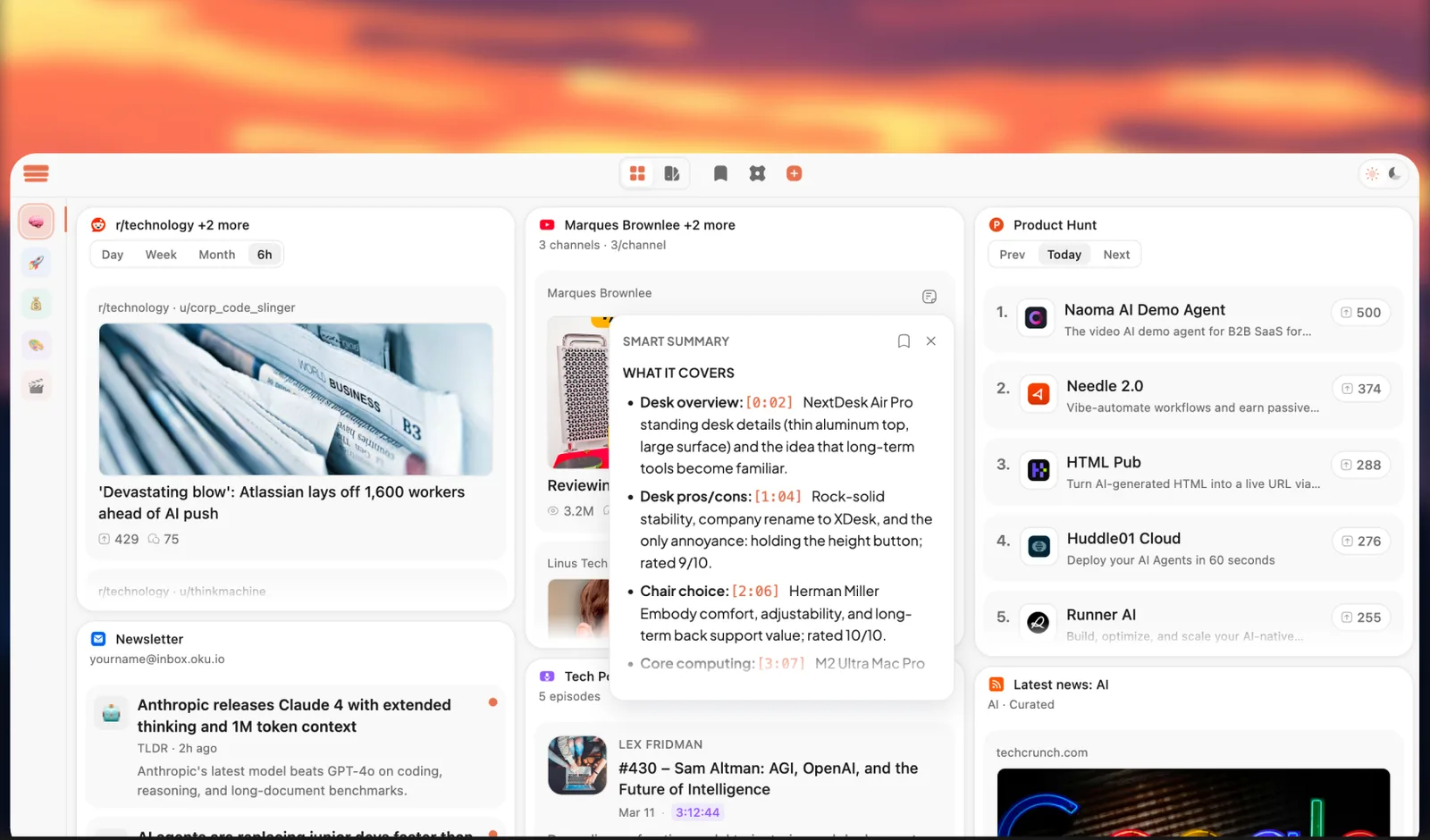
Once you find a few sources worth following, the next problem is keeping track of them. Oku helps you organize all your feeds and sources in one place. News, youtube channels, podcasts, reddit and a lot more either in a grid view to monitor everything easily, a focus view to check one feed at a time, or a daily email digest with only the most important content of the day. Try it free.
Final take
If you want the safest shortlist, start with: